
CHANNELS

infoTECH Feature
December 16, 2008
Ranking Risks: Rare to Certain, Negligible to Catastrophic
 By
By Risk is a concept that denotes a potential negative impact to an asset or some characteristic of value that may arise from some present process or future event. In everyday usage, risk is often used synonymously with the probability of a known loss. Risk is measured in terms of impact and likelihood. Since risk is directly correlated to loss, it is important to be able to assess risks in one’s business and to address them. Needless to say, inattention to risks can definitely affect a company’s bottom line.
Some businesses work without a formal risk assessment policy, nor use a unit that directly assesses the impact of risks in the organization. We have been so accustomed to risk in our everyday lives that the tendency is to ignore minor ones and react when major ones occur. Moreover, effective risk management carries with it some costs, which, when presented to stakeholders, naturally would lead to questions on how the costs could be justified.
Risk management is a modern buzz word but in no means a new science. More and more businesses and organizations recognize the need to identify risks within them so that they can be controlled and mitigated. It is important to exercise risk mitigation when it affects people, the environment, and one’s business, to name a few. Risk avoidance cannot make the potential of even greater loss from happening go away.
The question is, as a manager, how would I know which particular sets of risks need a special level of attention? Given limited resources, how would I know which particular types of risks need to be prioritized and addressed?
A risk matrix is a risk assessment tool which exposes aspects of risks that could be subjected to some form of ranking. The matrix has ranges of consequence and likelihood as axes. A risk matrix shows the manager and the decision maker a clearer view of what the risk is, what is involved (in terms of procedural changes, costs, behavioral adjustments, and the like), and what amount of time can be afforded given the severity and probability of the risk event. It can help a manager visualize, in an organized manner, the risks he or she faces in quantitative and qualitative terms and plan and make a more informed decision when the situation arises.
How does one construct an effective risk matrix?
Identify what the risk matrix is to be used for. Normally a risk matrix is called for during exercises involving hazard analyses, facility siting studies, and safety audits. Depending on the intended use of the matrix, one may need to establish tolerance or risk acceptability levels and a means of assessing the effectiveness of risk mitigation measures.
Define consequence and likelihood ranges. A typical risk matrix is a four by four grid. On the Y (vertical) axis is the “Probability/likelihood” description range while on the X (horizontal) axis is the “Consequence” range.
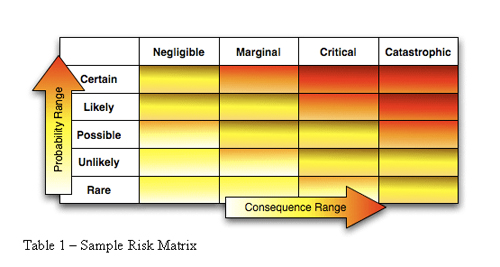
Consequences of risks as laid down in the grid use descriptive words and are ranked according to severity: Negligible, Marginal, Critical, and Catastrophic. Negligible risks are the least severe and would be assigned the lowest rank. Inversely, catastrophic risks are those that would be first in the severity ranking. Determine tolerance by assigning dollar values to each severity ranking, as well as some qualitative characteristics of the consequence being described. For example, Negligible Risks are those that involve $2,000 but less than $10,000 and could result in minor illness or injury to employees not exceeding a day, does not violate laws, or has little or minimal environmental damage and will be assigned Rank 1 in the matrix. Catastrophic Risks are those that involve USD 1M, could result in death or permanent disability, result in irreversible environmental damage or permanent closure to business, and will be assigned Rank 4 in the matrix.
|
Rank
|
Range
|
Amount of Loss in USD
|
Description of Loss
|
|
4
|
Catastrophic
|
1M or more
|
- Results in death or permanent disability of employees
- Irreversible environmental damage - Closure to business |
|
3
|
Critical
|
200,000 but less than 1M
|
- Results in partial permanent disability, injuries or illness of 3 employees or more
- Reversible environmental damage - Violation of law/regulation |
|
2
|
Marginal
|
10,000 but less than 200,000
|
- Injury or illness of resulting in one or more work days lost
- Mitigable environmental damage where restoration activities can be done |
|
1
|
Negligible
|
2,000 but less than 10,000
|
- Minor illness or injury to employees resulting in one day’s absence
- Does not violate laws - Little or minimal environmental damage |
Table 2 – Sample Consequence Ranking
The Probability axis describes the likelihood of the risk happening and can be assigned either Frequent, Probable, Occasional, Remote, or Improbable, or simply Certain, Likely, Possible, Unlikely, or Rare. Again, it would be helpful to state the likelihood criteria in numeric terms (example, “Possible” means the risk will occur several times in a lifetime but not less than 10 times nor over 100 times in that lifetime) and to assign logical rankings.
|
Rank
|
Range
|
Probability (over the life of a business)
|
Description
|
|
5
|
Certain
|
Once in 2 years
|
Continually experienced
|
|
4
|
Likely
|
Once in 4 years
|
Will occur frequently
|
|
3
|
Possible
|
Once in 6 years
|
Will occur several times
|
|
2
|
Unlikely
|
Once in 12 years
|
Unlikely, but can be reasonably expected to occur
|
|
Rare
|
Once in 24 years
|
Unlikely to occur, but possible
|
|
Table 3 – Sample Probability Ranking
Once the criteria for consequence and likelihood has been laid down, proceed to determine specific incidents, events or conditions that pose risk for the business and assign them along the blocks in the matrix. Example of an incident in the office would be ‘burst pipes and leaks” – this could be assigned in the block Rare (Rank 5 Likelihood) and Negligible (Rank 1 Consequence).
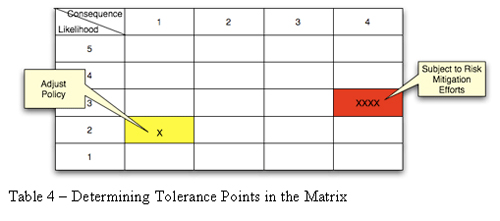
Translate the tolerability criteria into the matrix. The design of the matrix should be able to show clearly which of the blocks are intolerable or tolerable. For example, a Possible (Rank 3 Likelihood) intersecting with a Catastrophic (Rank 4 Consequence) would be intolerable for any business, given the description and values you have previously assigned. This block is a clear subject of risk mitigation efforts in the organization compared to a block (risk) pertaining to a Negligible (Rank 1 Consequence) intersecting with a Certain (Rank 2 Likelihood) which could be addressed, say, with a simple change or adjustment in organizational policy.
Care in assigning values
Risk matrices are fairly easy to construct and understand. However, one has to be careful in assigning values, taking care not to be overly quantitative and not affording to include what is called a ‘layer of protection’ approach—a means of including protective measures, which, when applied, brings down the risk a level lower. As in all planning and risk management efforts, it is recommended that the risk planner or analyst, even the manager, exercise conservatism in its design as well as point out areas of alarm. Decision makers are recommended to use this tool in policy formulation and include budgetary allocations to address not only persistent risks but also be ready for potentially catastrophic ones.
ExecutiveBrief, the technology management resource for business leaders, offers articles loaded with proven tips, techniques, and action plans that companies can use to better manage people, processes and tools – the keys to improving their business performance.
To learn more, please visit: http://www.executivebrief.com.
TMCnet publishes expert commentary on various telecommunications, IT, call center, CRM and other technology-related topics. Are you an expert in one of these fields, and interested in having your perspective published on a site that gets several million unique visitors each month? Get in touch.
Edited by Michelle Robart
|
|
FOLLOW US |  |
 |
 |
infoTECH Headlines
Exchange Server Recovery: Best Practices for Production Environment
Beyond the headlines: translating the Mythos risk for business leaders
cdmon Supports Online Businesses with Hosting, Domains and Digital Infrastructure Services
Why Hiring a Commercial Electrician in Keller Matters for Business Safety, Efficiency, and Growth
Are You Giving Your Agentic AI Too Much Access? Is it Impacting Compliance?
The Future of AI: Autonomous Training Models That Learn Continuously
How to Migrate from One Microsoft 365 Account to Another?
Simulating Your Worst-Case Scenario and Keeping Tabs on New Threats Using AI Systems
From Reactive to Proactive: Using AI to Hunt BEC in Real Time
Strengthening Tampa Businesses with Expert Cybersecurity Solutions
infoTECH Whitepapers