
CHANNELS

infoTECH Feature
IT at a Crossroads: Liberating and Securing the Mobile Workforce
 By
By Although some employers are reluctant to embrace the trend of the mobile workforce, 24 percent of Americans are spending at least a portion of their week working from home, according to the Bureau of Labor Statistics.
This trend presents a challenge for businesses that need to balance this demand with keeping their data accessible and secure at the same time. In fact, IT is at a very critical crossroads: the need to secure critical corporate data, apps, networks and end-users wanting to use the latest devices to be more productive in their day-to-day work.
This balancing act is complicated for IT and legacy solutions, especially when it comes to the mobile workforce. In fact, while 91 percent worry about sensitive company/customer info leaks and compliance related issues, another 46 percent want to increase productivity by enabling data access offline, according to a recent MokaFive survey of 8,000 IT executives.
The myriad of devices and operating systems mobile workers have available today allows them to be productive outside the walls of the office – and that trend is only going to continue to grow.
In terms of finding the right solution, the survey found that 89 percent use a virtual private network (VPN), however, pointed out that VPN does not fully protect data – and is therefore an inadequate solution.
“Without Wi-Fi connection, and consequently to no VPN, users are unable to access their data, which severely limits productivity,” a MokaFive infographic (see below) explained. “VPN does not partition between personal and company data. In other words, sensitive corporate/customer information could easily be stored on an unsecure device.”
Ultimately, the bottom line is for IT to achieve balance with agile management and empower the mobile workforce – anywhere, anytime and on any device.
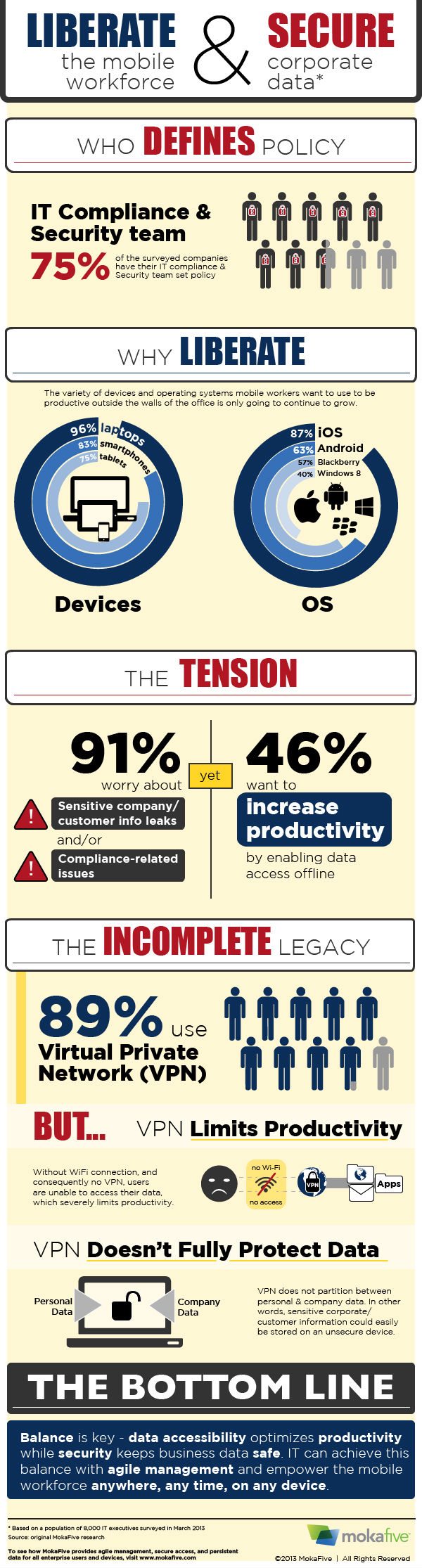
Infographic via MokaFive
Edited by Alisen Downey
|
|
FOLLOW US |  |
 |
 |
infoTECH Headlines
cdmon Supports Online Businesses with Hosting, Domains and Digital Infrastructure Services
Why Hiring a Commercial Electrician in Keller Matters for Business Safety, Efficiency, and Growth
Are You Giving Your Agentic AI Too Much Access? Is it Impacting Compliance?
The Future of AI: Autonomous Training Models That Learn Continuously
How to Migrate from One Microsoft 365 Account to Another?
Simulating Your Worst-Case Scenario and Keeping Tabs on New Threats Using AI Systems
From Reactive to Proactive: Using AI to Hunt BEC in Real Time
Strengthening Tampa Businesses with Expert Cybersecurity Solutions
How Knowledge Management Software is Transforming Modern IT Operations
2025 Online Casino Trends: What to Expect in the Next 12 Months
infoTECH Whitepapers